The purpose of this document is to define the step-by-step procedures, resources, and safety protocols required for the safe and correct installation, testing, and commissioning of the Heating, Ventilation, and Air Conditioning (HVAC) systems.
Below procedure highlights general requirements and each system requires detailed method statement which is required for submission to consultant for approvals.
The scope of this document includes:
-
Pre-installation site inspection and material handling.
-
Installation of ductwork, dampers, and insulation.
-
Installation of major equipment (Chillers, AHUs, FCUs, and Condensing Units).
-
Refrigerant and chilled water piping installation.
-
Testing, Balancing, and Commissioning (T&B / TAB).
References & Standards
All works shall be executed in strict compliance with the project specifications, approved shop drawings, and the following international standards:
-
SMACNA: HVAC Duct Construction Standards (Metal and Flexible).
-
ASHRAE: Handbooks for HVAC Systems and Equipment.
-
NFPA 90A & 90B: Standard for the Installation of Air-Conditioning and Ventilating Systems.
-
Local Authority Regulations: Civil Defense and Environmental Health & Safety (EHS) requirements.
Roles & Responsibilities
Project Manager shall be overall responsible for project execution, schedule adherence, and resource allocation. Also implementation of all QHSE requirements.
Site Mechanical Engineer shall supervise day-to-day installation, ensure compliance with approved shop drawings, and coordinate with other trades.
HSE Officer shall conduct tool-box talks, inspect rigging/lifting gear, ensure personal protective equipment (PPE) compliance, and monitor safe work practices throughout the installation works.
QA/QC Engineer shall perform routine inspections, manage Material Inspection Requests (MIR), and oversee the Work Inspection Requests (WIR) for installation, testing and commissioning phases.
Foreman / Technicians shall execute physical installations at the site according to instructions, maintaining clean and orderly workspaces.
Materials & Equipment
Approved Materials
-
Galvanized Iron (GI) Sheets for ductwork (conforming to ASTM A653).
-
Pre-insulated pipes and acoustic/thermal insulation materials.
-
Refrigerant piping (Type L copper) and chilled water steel piping.
-
Inline fans, Air Handling Units (AHUs), Fan Coil Units (FCUs), and Chillers.
Tools & Equipment
-
Duct lifters, chain blocks, and mobile cranes (with valid third-party certificates).
-
Scaffolding towers and ladders.
-
Welding machines, pipe cutters, and threading machines.
-
Commissioning Tools: Digital anemometers, manometer/pitot tubes, sound level meters, and calibrated pressure gauges.
Detailed Installation Procedure
Pre-Installation Requirements
Verify that all civil structures, housekeeping pads, and wall openings are ready and dimensions match approved drawings.
Inspect all HVAC equipment upon arrival for any transit damage. Submit a Material Inspection Request (MIR) to the consultant before shifting materials to the installation zone. Consultant or client approval is mandatory before starting the installation works.
Ensure all workers attend a specific HSE briefing regarding working at heights and manual handling, also covering all requirements of risk assessment or job safety analysis.
Ductwork Installation Procedure
Marking & Support Fixings: Mark the duct layout on the ceiling slab. Install approved anchor fasteners and threaded hanger rods at specified intervals (typically every 2.4 to 3 meters, per SMACNA).
Assembly: Assemble duct sections on the ground using approved gaskets, bolts, and cleats to ensure airtight joints.
Lifting & Alignment: Lift duct sections into place using duct lifters or material lifts. Secure them onto the support channels.
Insulation: Apply approved adhesive to the outer surface of the ductwork and wrap it tightly with insulation fiberglass/elastomeric foam. Seal all joints completely with aluminum foil tape to eliminate thermal bridging.
Dampers & Grilles: Install Volume Control Dampers (VCDs), Fire Dampers (FDs), and air terminals (diffusers/grilles) according to the approved architectural layouts.
HVAC Equipment Installation (AHUs, FCUs, Chillers)
Foundation Preparation: Verify the concrete housekeeping pads are level and install anti-vibration rubber pads or spring isolators.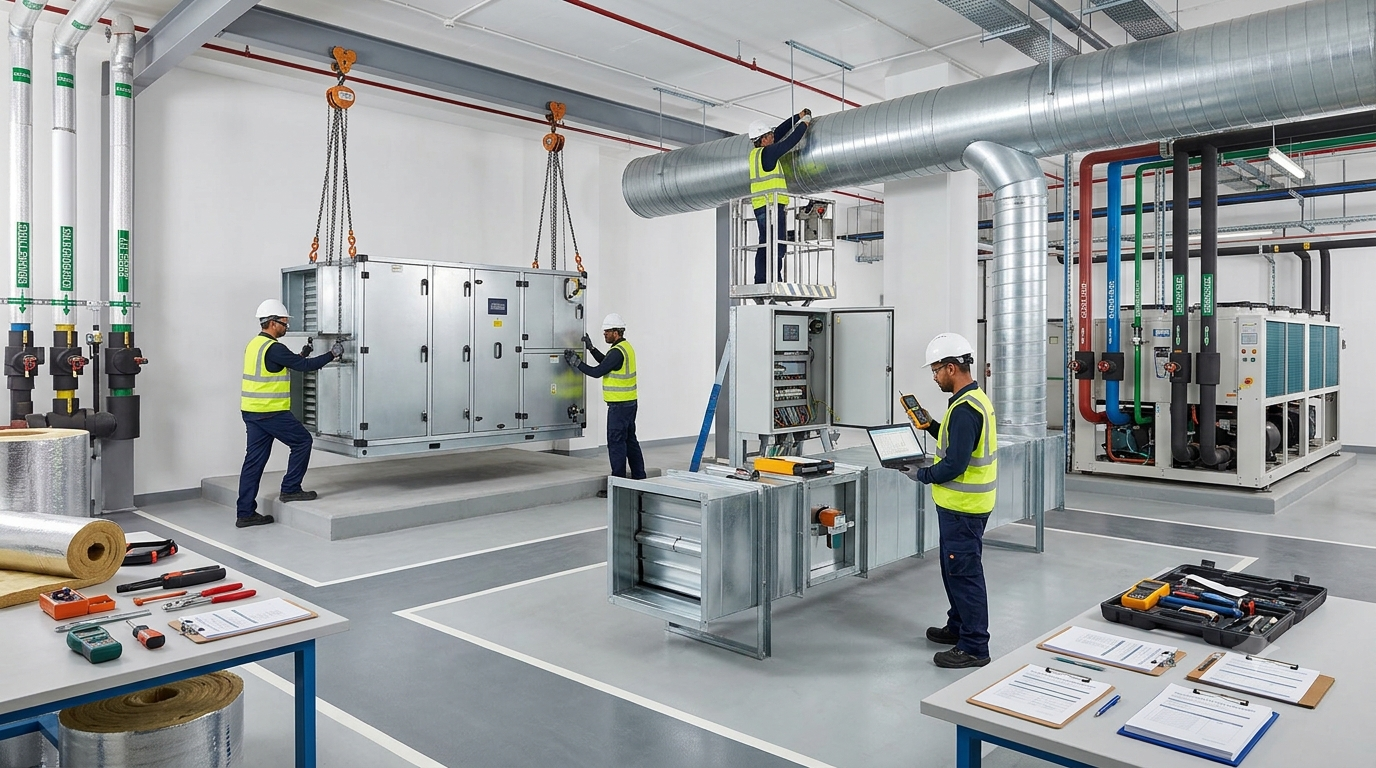
Rigging & Shifting: For heavy equipment (Chillers/AHUs), use a certified crane and rigging crew. Ensure lifting points match manufacturer instructions.
Securing Equipment: Align the equipment perfectly on its foundation and anchor it securely.
Piping & Duct Connections: Connect ductwork using flexible canvas connections to prevent vibration transmission. Connect chilled water/refrigerant lines using flexible pipe connectors, ensuring proper isolation valves and strainers are installed on the return and flow lines.
Piping Work (Chilled Water & Refrigerant)
Install pipe supports (clevis hangers, roller supports) with wooden/phenolic insulation shields to prevent crushed insulation.
Weld or thread steel piping depending on pipe size.
Run nitrogen gas through copper refrigerant lines during brazing to prevent internal oxidation.
Apply pressure testing to the piping network prior to insulation application.
Testing & Commissioning Procedure
Pre-Commissioning Checks (Static Checks)
Ductwork Leakage Test: Perform a smoke or light test on selected duct sections per SMACNA criteria to ensure leakage rates are within acceptable limits.
Piping Hydrostatic Test: Pressurize chilled water piping to 1.5 times the working pressure (or as specified) for a minimum of 24 hours. Check for leaks or pressure drops.
Flushing & Chemical Treatment: Flush the chilled water system thoroughly to remove debris, and add approved corrosion inhibitors/biocides.
Electrical Checks: Check power supply voltage, phase rotation, and verify that overload relays, earthing, and control wiring are correctly terminated.
Testing, Adjusting, and Balancing (TAB)
-
-
Start the AHUs/fans and measure the total airflow ($Q = V \times A$) at the main duct using a pitot tube traverse.
-
Adjust the main Volume Control Damper (VCD) until the total design airflow is achieved.
-
Adjust individual branch VCDs and terminal grilles using a digital anemometer or capture hood until air distribution matches the design specifications within a $\pm 10\%$ tolerance.
-
Hydronic Balancing:
-
-
Measure the total water flow across the chillers and pumps using calibrated pressure gauges across circuit balancing valves.
-
Adjust regulating valves until the design flow rate ($\text{L/s}$ or $\text{GPM}$) is achieved across all coils and equipment.
-
Performance Testing & Commissioning
Run the system continuously for a 24-to-72-hour trial period.
Measure and record room temperatures, relative humidity (RH), and ambient conditions during peak hours.
Record equipment parameters: motor running current (Amps), voltage, compressor discharge pressures, entering/leaving water and air temperatures.
Verify the functionality of automatic control systems (BMS interface, thermostats, and fire alarm interlocks for fire damper closure).
Quality Control (QC) Records & Documentation
The following documents must be signed off by the QA/QC Engineer and Project Consultant to successfully conclude the works:
-
Material Inspection Reports (MIR).
-
Duct Leakage & Hydrostatic Pipe Test Certificates.
-
Equipment Pre-Commissioning Checklists.
-
Final Approved TAB (Testing and Balancing) Report.
Health, Safety, and Environment (HSE)
PPE: Mandatory use of safety helmets, steel-toed boots, high-visibility vests, safety glasses, and gloves. Harnesses must be worn when working above 1.8 meters.
Risk Assessment: A specific Job Safety Analysis (JSA) for hot works (welding/brazing) and heavy lifting must be communicated to the crew before work begins.
Housekeeping: All insulation waste, sheet metal off-cuts, and chemical containers must be disposed of safely in designated site skips daily.
Attachments
- Inspection and Test Plan ITP
- Inspection Checklists
- Risk Assessment
- Manufacturer Instructions
Discover more from Method Statement Store
Subscribe to get the latest posts sent to your email.